

 Mr. Shaik Thaheer
Sleep technologist in Amara Sleep Clinc Tirupati
Certified Sleep Technologist by IBSM
Msc, Bsc Microbiology and Inter in MLT
Biocalibration are a sequence of commands given to the patient to verify and document appropriate responses and realiability of sensor application. The purpose of performing biocalibration is to have a baseline for scoring reference and to check potential problems such as loose electrodes, dislodged sensors or 60Hz interference. Biocalibration is also called Physiological Calibration.
In our lab Biocalibration is performed at the start of the study to ensure good quality signals. American Association of Sleep Medicine (AASM Scoring Manual v2.4) recommends doing it at the start and end of the study.
Biocalibration is performed before lights off command. If we do biocalibratiion after lights off command, it will unnecessarily prolong Sleep Onset latency.
AASM Sleep Scoring Manual v2.4 recommends the following biocalibration commandsa.
A. Ask the patient to Open eyes for 30 sec (Fig:2)
B. Ask the patient to Close eyes for 30 second- Alpha activity should appear in EEG leads (Fig:1)
C. Ask the patient to Blink eyes for 5 times (Fig:3)
D. Ask the patient to Look up and down without moving the head10 times (Fig:4)
E. Ask the patient to Look left and right 10 times without moving the head
F. Ask the patient to Grit/chew teeth for 5 sec (Fig:5)
G. Ask the patient to simulate snore or hum for 5 sec
H. Ask the patient to breathe normallyensure airflow and effort channel signal are synchronized
i. Ask the patient to hold his breath for 10 sec (Fig:8)
j. Ask the patient to breathe through mouth only for 10 sec (Fig:8)
K. Ask the patient to breathe through nose only for 10 sec
L. Ask the patient to flex his left foot for 10 times (Fig:7)
M. Ask the patient to flex his right foot 10 times (Fig:7)
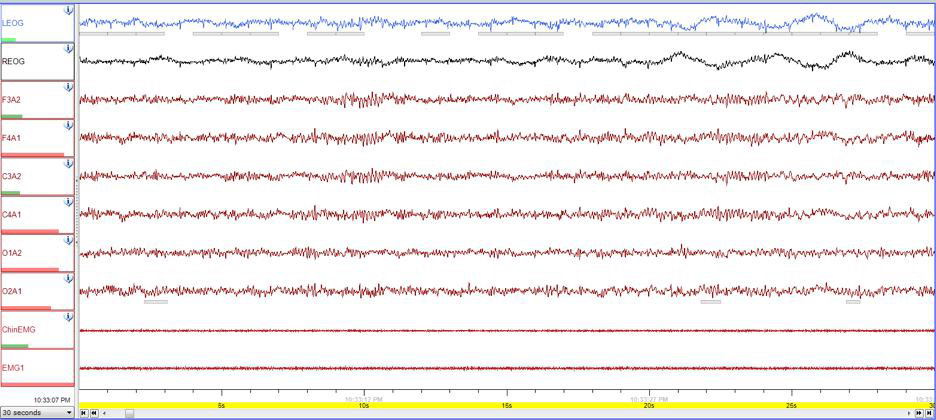 Fig:1 Biocalibration command “Close your eyes for 30sec”. Note the prominent alpha activity in all the EEG channels. Epoch duration: 30sec.
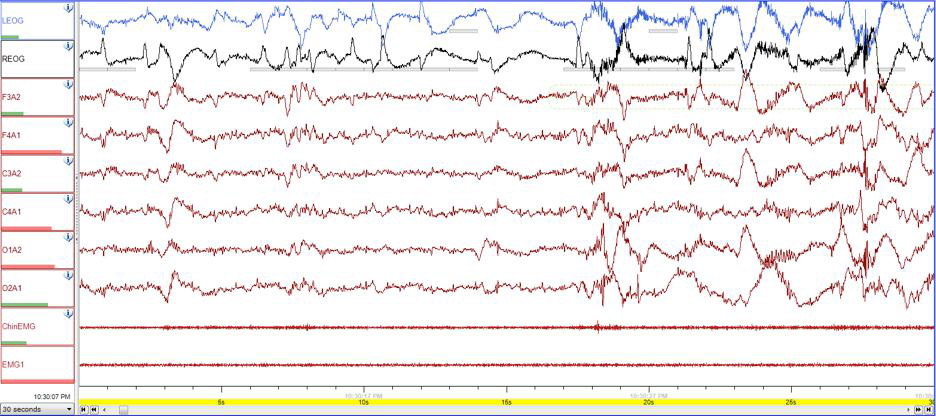 Fig:2 Biocalibration command “Open your eyes for 30sec”. Note the disappearance of alpha activity in the EEG channels. Epoch duration: 30sec.
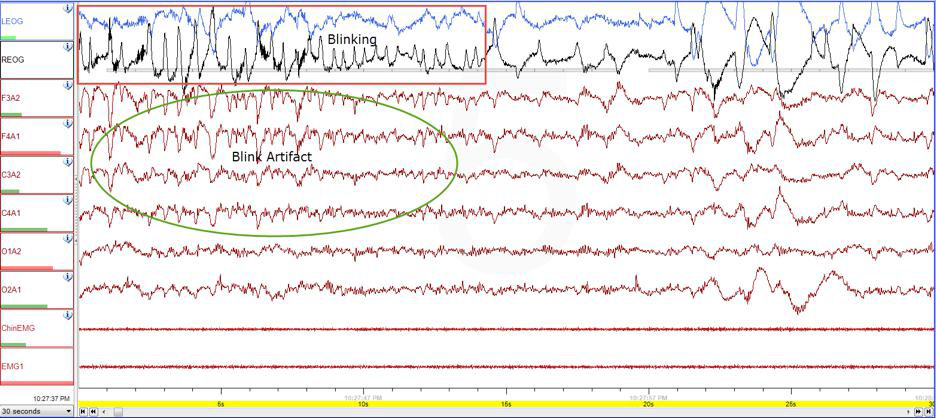 Fig:3 Biocalibration command “Blink 10 times”. Look at LEG and REOG channels, blinking is seen and patient blinked for 28 times (Red Box). Blinking is reflected in EEG channels as well and it is referred to as Blink artifact (Green Circle).
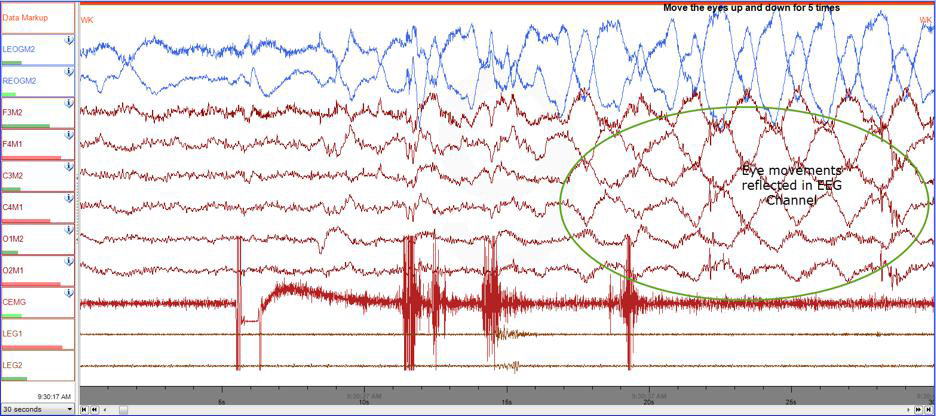 Fig:4 Biocalibration command “Move the eyes up and down 5times”. LEOG and REOG channels show eye movements and eye movements are reflected in EEG channels as well (Green Circle).
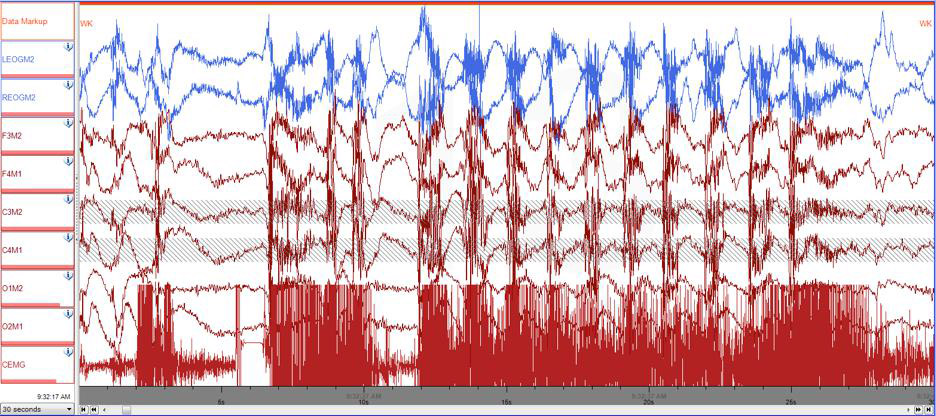 Fig:5 Biocalibration command “Chew your teeth for 10 sec”. Activity in CEMG channel increases which is reflected in EEG and EOG channels as well. Epoch duration: 30sec
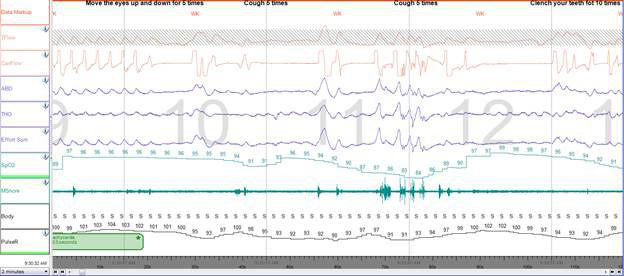 Fig:6 Biocalibration command “Cough 5 times”. Snoring channel “MSnore should pick up the signal. Epoch duration: 2min
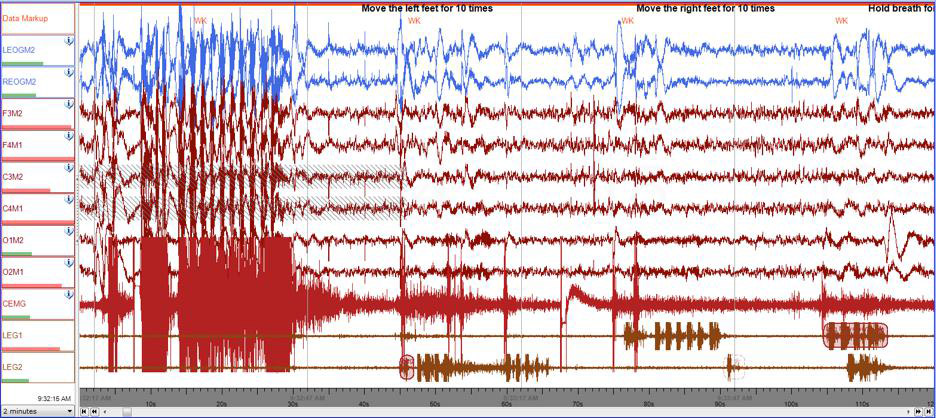 Fig:7 Biocalibration command “Move your left feet for 10 times” and “move right feet for 10 times”. Leg2 channel is indicating sensor on left leg and Leg 1 channel is indicating sensor on right leg. During this command you need to pay attention to activity in leg channels.
For next figure please refer to the following Channel labels-
TFlow- airflow from Thermistor
CanFlow- airflow from pressure transducer
ABD and THO- Respiratory effort from Abdomen and Thorax
MSnore- snoring sound from microphone
SpO2- Oxygen Saturation
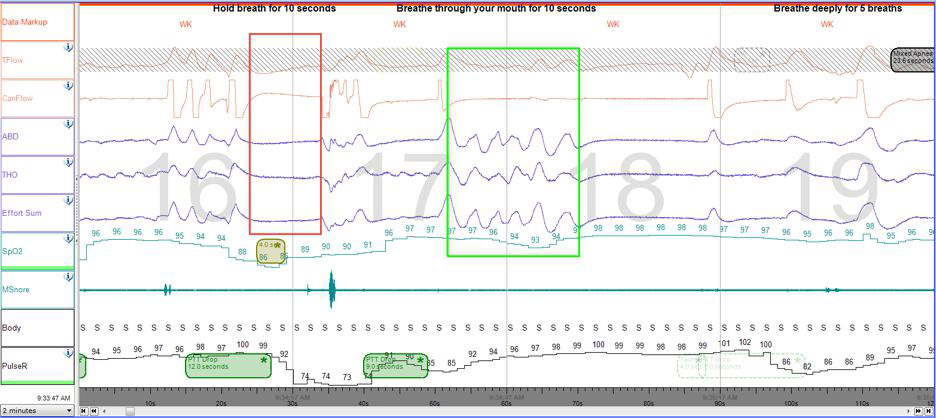 Fig:8 Biocalibration command “Hold breath for 10 sec” and “Breathe through your mouth for 10sec”. The patient is using nasal cannula (CANFlow) and oro-nasal thermistor (TFlow). When patient holds his breath signal in Tflow, CanFlow, ABD and THO becomes flat mimicking Central Apnea (Red Box). When patient breathes through his mouth signal in CANFlow becomes flat but TFlow is recording airflow from mouth and respiratory effort is present (Green Box). Epoch duration: 2min.
The impedance for EEG, EOG and chin EMG leads should be below 5k ohms. As for leg EMG leads, impedance need to be less than 10k ohms.
Some of the Biocalibration commands in below epochs are little different from AASM recommendation but capture the essence of the command.